
Meet Protect: The Botanical Blend Every Apothecary Needs (Yes, Even Yours)
Okay so... let's talk about the thieves.
There's a story behind blends like this one that's been passed around since the 1400s. As the legend goes, a band of very enterprising (and very morally questionable) robbers in plague-ridden Europe used to coat themselves in a mix of clove, cinnamon, rosemary, and a few other potent botanicals before looting the homes of the dead and dying. Nobody's ever proven whether that actually kept them well. It's folklore, not a clinical study. But it's a genuinely great story, and it's the reason blends like this one still carry names like "Thieves" to this day.
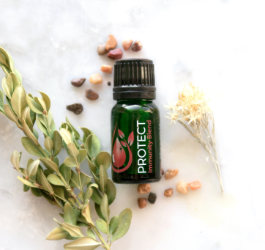
Fast forward a few centuries and we've bottled that same warm, spicy, historically-inspired energy into Protect - Immunity Blend. It's our take on the essential oil blend you probably already know by another name: five pure essential oils working together to fill your space with warmth, comfort, and that cozy, "something good is happening in here" feeling.
So let's talk about why this blend deserves real estate in your apothecary. No matter what kind of oil person you are.
What's Actually Inside This Blend
Protect is a blend of clove, lemon, cinnamon bark (Ceylon), eucalyptus radiata, and rosemary essential oils. Five oils, one very cozy purpose.
We're not going to sit here and tell you this exact bottle has been through a clinical trial. It hasn't, and we're not about to pretend otherwise. But the individual botanicals in it have a real research history behind them, mostly around their aromatic compounds. And honestly? We think that's worth knowing, so here's what's actually out there, in plain terms.
Clove oil. Its primary compound, eugenol, has been studied in laboratory settings for its antimicrobial and antifungal properties (Hu et al., 2018, Journal of Food Science).
Cinnamon bark oil. Its dominant compound, cinnamaldehyde, has shown antimicrobial activity in vitro, along with antioxidant and immune-modulating effects under lab conditions (2025, International Journal of Molecular Sciences).
Lemon oil. Its main compound, limonene, has shown broad-spectrum antimicrobial activity in laboratory testing (2021, Frontiers in Chemistry).
Eucalyptus radiata. Its primary compound, 1,8-cineole, has shown antimicrobial activity in vitro (2016, Journal of Essential Oil Research).
Rosemary oil. Its compounds, 1,8-cineole and alpha-pinene, have shown antimicrobial and antioxidant activity in lab settings (Journal of Agricultural and Food Chemistry).
And the blend-level study behind it all. Back in 1998, researchers at Weber State University diffused a comparable five-oil blend inside a sealed lab chamber and tracked changes in airborne bacteria levels over a short diffusing period, under those specific, controlled conditions (Chao, Young & Oberg, 1998, Journal of Essential Oil Research).
To be clear: that's what those studies found, about those individual compounds, in the specific lab settings researchers tested. While Protect itself has been tested this way, or that it will do the same thing in your living room. This is educational information about the botanicals inside the blend, not a claim about the finished product. Protect is not intended to diagnose, treat, cure, or prevent any disease, and the FDA hasn't evaluated these statements.
Which "Protect Person" Are You?
Here's the beautiful thing about this blend. It genuinely does not care who you are. It just works. But if you're trying to figure out where it fits into your particular brand of chaos, we've got you.
The Overwhelmed Mom. You've already got a diffuser going in every room and approximately eleven other things happening at once. Protect goes in the diffuser during the busy season, on little feet (diluted, always), and, let's be honest, in your own personal inhaler for the days you need one small thing to smell good and feel like a tiny reset. Keep it close.
The Skeptic Who Wants Receipts. You're not here for vibes, you're here for data. Good news: you just read a whole section of studies above. Eugenol, cinnamaldehyde, 1,8-cineole, limonene, alpha-pinene... these are compounds that keep showing up in published research on antioxidant and antimicrobial properties. Go read the citations yourself. Draw your own conclusions. Then come back for the oil.
The Clean-Home Devotee. You already know your favorite cleaning products smell like nothing without a little help. Add a few drops of Protect to your dishwasher, your DIY spray, your mop water. It brings that warm, spicy, "something good just happened in this kitchen" scent to your whole cleaning routine.
The Aromatherapy Purist. You want your home to feel like a hug. Protect diffused alone, or blended with a little orange or fir, is grounding and warm and genuinely gorgeous. This isn't a medicinal-smelling oil. It's cozy in a way that makes people ask what candle you're burning.
The On-the-Go Wellness Girlie. Between school drop-off, work, and whatever's on today's list, you need something fast. A personal inhaler with Protect lives in your bag, your car, your desk drawer. Quick sniff, reset, keep moving.
The New-to-Oils Friend. Maybe someone handed you a bottle of this once and you never quite got the hang of it. Maybe you're just oil-curious. Either way, this is a genuinely easy, forgiving place to start. Diffuse it, dilute it, put it in your cleaning spray. You really can't mess this one up.
Your Apothecary Called
Warm, spicy, a little bit historic, and grounded in real botanical research, Protect earns its spot on the shelf next to your other daily essentials. Whether you're diffusing it through the cozy season, adding it to your cleaning routine, or just want your home to smell like it has its life together (even when you don't)... this is the blend that does a little bit of everything.
Safety notes: For external use only. Dilute before applying to skin. Avoid contact with eyes. Keep out of reach of children. If irritation occurs, discontinue use. This product is not intended to diagnose, treat, cure, or prevent any disease. Statements have not been evaluated by the FDA. For educational purposes only.
Sources
Hu, Q. et al. (2018). Progress on the Antimicrobial Activity Research of Clove Oil and Eugenol in the Food Antisepsis Field. Journal of Food Science. https://ift.onlinelibrary.wiley.com/doi/10.1111/1750-3841.14180
Comprehensive Phytochemical Analysis and Evaluation of Antioxidant, Antimicrobial, Cytotoxic, and Immunomodulatory Activities of Commercial Cinnamon Bark Essential Oil (2025). International Journal of Molecular Sciences. https://pmc.ncbi.nlm.nih.gov/articles/PMC12250438/
Frontiers in Chemistry (2021). Chemical Composition, Antimicrobial and Insecticidal Activities of Essential Oils of Discarded Perfume Lemon and Leaves. Frontiers in Chemistry. https://www.frontiersin.org/journals/chemistry/articles/10.3389/fchem.2021.679116/full
Journal of Essential Oil Research (2016). Chemical composition and antimicrobial activity of Eucalyptus radiata leaf essential oil, sampled over a year. https://www.tandfonline.com/doi/full/10.1080/10412905.2016.1175386
Journal of Agricultural and Food Chemistry. Antimicrobial and Antioxidant Properties of Rosemary and Sage Essential Oils. https://pubs.acs.org/doi/10.1021/jf0715323
Chao, S.C., Young, D.G., & Oberg, C.J. (1998). Effect of a Diffused Essential Oil Blend on Bacterial Bioaerosols. Journal of Essential Oil Research, 10(5). https://www.tandfonline.com/doi/abs/10.1080/10412905.1998.9700958